Last week I gave a talk at the San Francisco Cassandra Meetup about how we're using Cassandra at AdStage to track ad conversions. Lina, the meetup's organizer, was kind enough to record the presentation, so it's now available on YouTube.
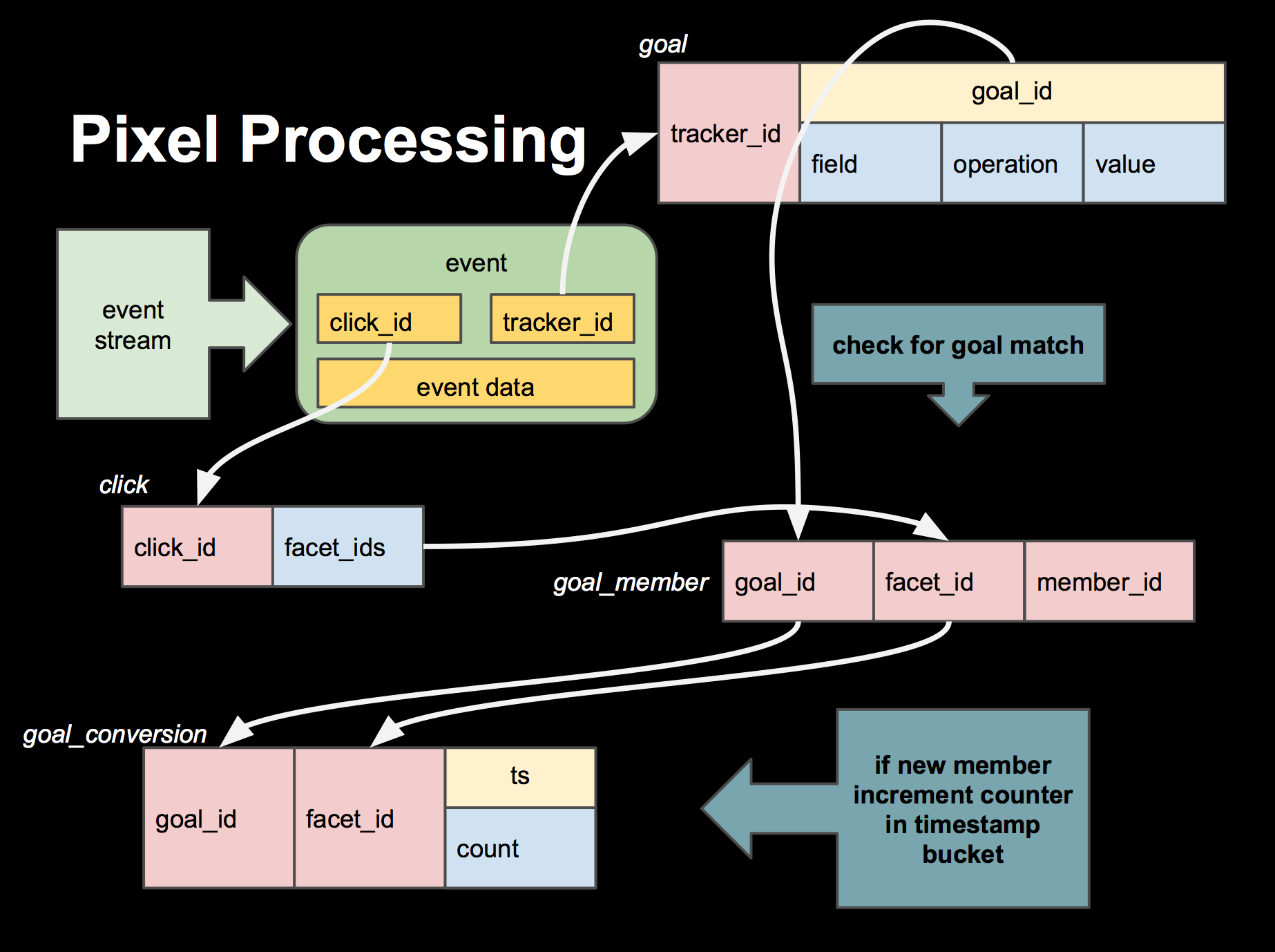
Just to add a couple of interesting details here, first, here are the schemas for the tables I discussed in the talk so you can get a better idea of what they look like:
CREATE TABLE goal (
  tracker_id text,
  goal_id text,
  field ascii,
  operation ascii,
  value text,
  PRIMARY KEY ((tracker_id), goal_id)
);

CREATE TABLE click (
  click_id text,
  facet_ids list<text>,
  PRIMARY KEY ((click_id))
);

CREATE TABLE goal_member (
  goal_id text,
  facet_id text,
  member_id text,
  PRIMARY KEY ((goal_id, facet_id, member_id))
);

CREATE TABLE goal_conversion (
  goal_id text,
  facet_id text,
  ts timestamp,
  "count" counter,
  PRIMARY KEY ((goal_id, facet_id), ts)
);
And because it got cutoff in the video, here's the full diagram of how the tables are used from the slides.
And a quick shout-out to my coworker Eric because, if you look at the schemas above and are wondering "why is the primary key for a table like click written as ((click_id)) now instead of (click_id)?", it's because one day I was using Cassandra, failed to notice that PRIMARY KEY (partition_key, cluster_key) means 'partition by primary_key, cluster by cluster_key' rather than 'partition by primary_key and cluster_key' and saw some unexpected behavior. With Eric's help, though, we proposed a change that was merged into Cassandra 2.0.x so that the partition keys are always surrounded by parentheses even when the partition key is not compound to make the distinction clear.